
Hilton Head Island Warrant Checks
Hilton Head Island has no current town-court portal for a new municipal warrant search. Start with the court or agency named on the notice, and use the original case or ticket number. The island’s municipal-court structure changed after the Town dissolved its separate court, so an old heading may not describe the current custodian.
- Read the court name, date, and ticket or case number on the original notice.
- Use any listed Town-era court contact only to ask where the older file was transferred.
- Ask the current custodian to confirm whether it holds the case and any active order.
- For a new county case, follow the official Beaufort County route described in the county pages.
- Confirm status and appearance instructions with the responsible office before acting.
The Town Court Dissolved, So Verify the Venue
Hilton Head Island’s separate municipal court was dissolved in 2018–2019. That change matters when an older ticket still carries a Town court heading or a saved online page refers to a former counter. The date and number on the original notice help the current record holder identify what happened to the file.
Do not assume that a historical court label is the office that can confirm current status. Ask the official clerk to identify the present record custodian before making a payment or appearance.
Policing and Courts in Hilton Head Island
The Town has no separate municipal court for new cases and no stand-alone police department in the reviewed local structure. Law-enforcement service for the island is provided through the Beaufort County Sheriff’s Office. The town-court change is the important local feature: current municipal court questions should not be sent to an office that no longer operates.
For a historical ticket, use the court name and case number on the notice to ask where the record is held. A law-enforcement contact and a court clerk answer different questions, and only the court can explain an appearance requirement in its case.
Older Citations May Keep Their Original Heading
A citation issued before the town court closed may still use the former Hilton Head Island Municipal Court name, even if later court activity happened elsewhere. Keep the original citation and any later notice together. The case number, filing date, and caption help a clerk trace the record without treating the old heading as current venue.
If the paperwork has conflicting dates or court names, ask the custodian to identify the controlling docket. A stale notice should not be used to choose an appearance date or payment location without confirmation.
Warrants in Hilton Head Island: The Main Types
For current Hilton Head Island matters, the court level controls the warrant type. A county Magistrate or Circuit judge may issue process in a county case; the dissolved town Municipal Court no longer issues new warrants. Traffic, arrest, and bench-warrant questions therefore require the court and case number on the notice, rather than a search for a current Hilton Head town court.
| Warrant Type | How It Arises | Who Issues It |
|---|---|---|
| Traffic warrant | Missed obligation in a traffic case | Current county court listed on the citation |
| Bench warrant | Missed appearance or court requirement | Judge in the underlying county case |
| Arrest warrant | Judicial review of probable-cause information | Magistrate or other authorized judge |
| Older town-court matter | Prior Hilton Head municipal proceedings | Verify the present custodian; former town court dissolved |
No Current Town Warrant Portal Was Found
The reviewed Hilton Head Island materials do not identify a separate municipal warrant search or a current town-court listing page. A search result for the former court may be an archived notice rather than a current case record. Contact the office named in a current document to verify the docket before acting.
A missing page or online result cannot establish that an old case has ended. Ask the clerk to confirm whether the record was transferred, closed, or remains active under a later court entry.
Hilton Head Island Warrants: What They Show
No public Hilton Head warrant portal or standard local warrant-number pattern was identified. County case records may identify a court, cause number, charge, scheduled date, and bond direction, while a ticket search may show only citation and payment details. Ask the current custodian to confirm whether a warrant remains open and what the judge requires.
| Case or ticket number | Use the exact identifier on the notice; older files may use a former court label |
|---|---|
| Subject Name | Compare the full identity with the official court record |
| Charge / Offense | Read the filed allegation; it is not a case outcome |
| Issuing Court | Current county court or identified older town-court custodian |
| Bond / Fine Amount | Case-specific; verify with the court or Detention Center |
| Status | Ask whether process is active, served, or recalled |
Confirm an Old Payment Before Sending Another
A Town-era payment receipt may use a former court name and may not show whether a separate warrant was recalled. Keep the receipt and citation together, then ask the current clerk to confirm both the balance and any outstanding court action. Do not send a second payment based only on a stale screen.
For an old case that cannot be located by its original caption, give the clerk the ticket number and date and ask which record system now holds it. Wait for an official direction before mailing money or traveling.
Where Hilton Head Island Cases Go Now
Hilton Head Island no longer has a separate municipal court, and local law-enforcement service is provided through the Beaufort County Sheriff’s Office. Many later matters use the Bluffton Magistrate route identified by the county, while older town files may have a different caption. The county court routing notice identifies general venues, not an individual’s status. See Beaufort County warrant records and the county warrant-check page for current contacts and record coverage.
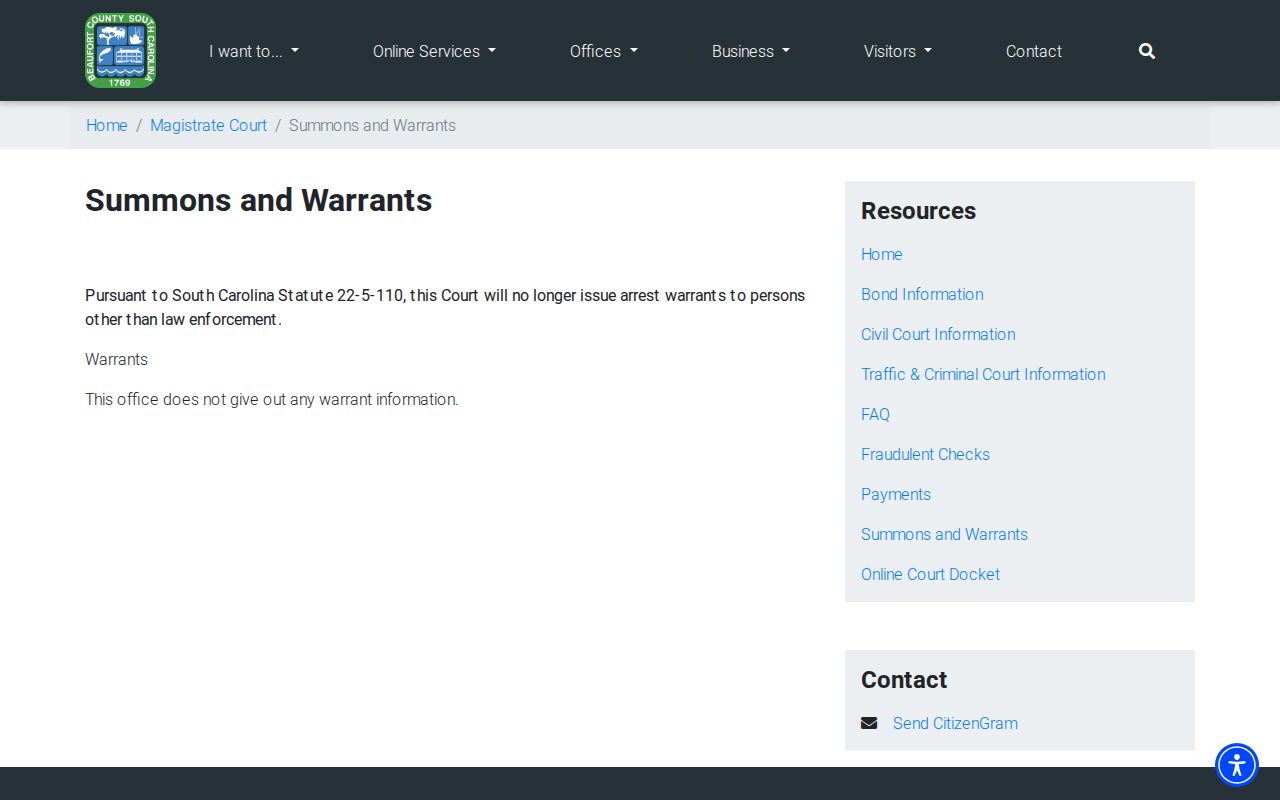
The county notice shows a general route, not confirmation of a person’s warrant status.
A Name Match Cannot Date an Older File
Hilton Head Island records span a transition from the former municipal court to the later county venue. A name-only search may return a similarly named person or an older citation without showing what happened afterward. Compare the full name, case number, and event date, then ask the record custodian to confirm the history.
If the old case remains unresolved, the court will explain the next appearance or payment step. Do not rely on a historic ticket image as proof of current status.
Keep Town-Era Paperwork With New Notices
When an older citation is followed by a later court notice, keep both documents available. The former town caption can explain where the case began, while a newer filing may identify the office now setting a date or accepting payment.
This record trail is especially useful for a relative helping resolve an old Hilton Head Island matter. A complete notice and case number let the official clerk distinguish the original ticket from a later event.
Accessing Hilton Head Island Warrants
South Carolina FOIA covers access to existing public-body records, subject to statutory limits, fees, and redactions. Ask the current county office for a record it maintains rather than requesting a new island warrant list. Juvenile matters and sealed or protected records may be unavailable to the general public. The office decides what can be released under the law.
Key Rules:
South Carolina Freedom of Information Act (SC FOIA) - public access to records held by public bodies, subject to exemptions and fees.
South Carolina Code § 22-5-110 does not let a private person apply directly to a magistrate for an arrest warrant; report concerns through law enforcement.
The Children’s Code limits access to youth case materials, including files under older Town captions.